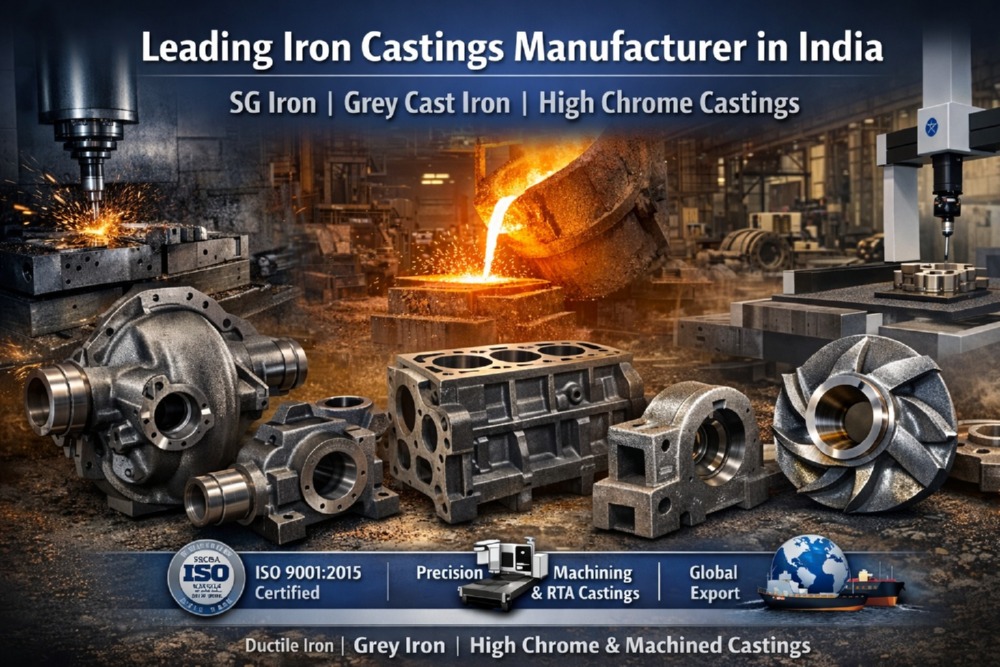
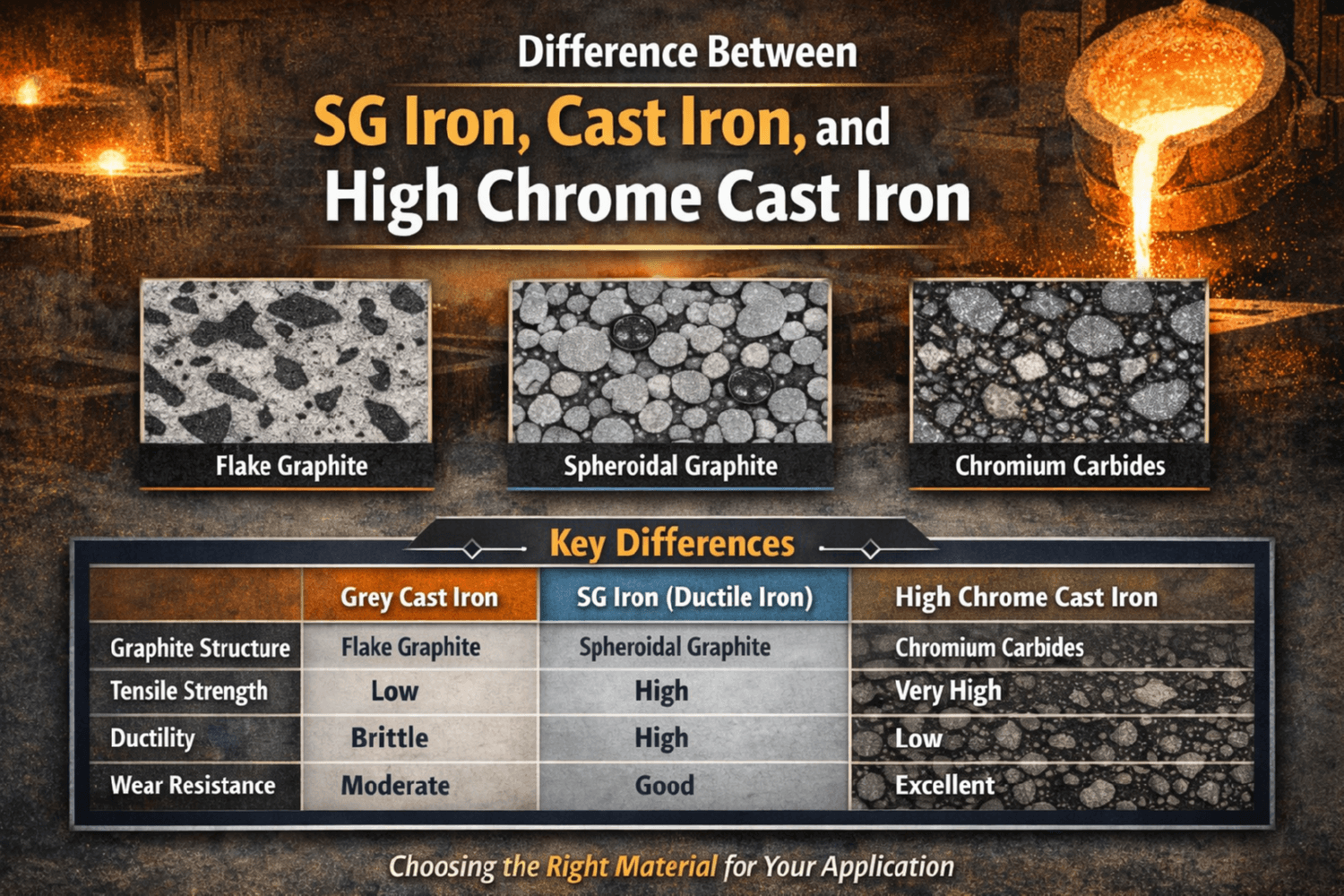
Difference between SG iron, cast iron, and high chrome cast iron
Difference between SG iron, cast iron, and high chrome cast iron – grades, properties, microstructure, and applications
Introduction
When engineers search for cast iron grades, SG iron properties, or the difference between SG iron and cast iron, they are usually looking for one thing — the right material for their application.
As a foundry manufacturing SG iron and cast iron castings, Shanthala Spherocast Private Limited frequently receives queries such as:
Which is better, SG iron or cast iron?
What is the difference between FG 260 and SG 500/7?
Can SG iron replace cast steel?
What heat treatment is required for SG iron?
What is cast iron?
Cast iron is an iron–carbon alloy containing 2.5% to 4.0% carbon, where carbon is present mainly in the form of graphite flakes.
These graphite flakes provide:
Excellent castability
Good machinability
High vibration damping
Lower tensile strength compared to SG iron
Cast iron is widely used where compressive strength, rigidity, and cost efficiency are more important than ductility.
What is SG iron (ductile iron)?
SG iron, also known as ductile iron or nodular iron, is a modified form of cast iron in which graphite is present as spheroidal graphite instead of flakes.
This spheroidal graphite structure is achieved by adding magnesium or cerium during molten metal treatment.
As a result, SG iron offers:
High tensile strength
Excellent ductility
Better fatigue resistance
Higher impact strength
Properties approaching cast steel
Key difference between cast iron and SG iron
quill.clipboard.dangerouslyPasteHTML(`
| Property | Grey Cast Iron (FG) | SG Iron (Ductile Iron) |
|---|---|---|
| Graphite shape | Flake graphite | Spheroidal graphite |
| Tensile strength | Low to moderate | High |
| Elongation | Almost zero | Up to 18% |
| Impact strength | Low | High |
| Machinability | Excellent | Very good |
| Weldability | Poor | Better than grey iron |
`);
Grey cast iron grades and properties (IS 210)
FG 200 – 200 MPa
FG 220 – 220 MPa
FG 260 – 260 MPa
FG 300 – 300 MPa
Typical applications include engine blocks, flywheels, gearbox housings, machine tool beds, and brake components.
SG iron grades and properties (IS 1865 / ASTM A536)
SG 400/15 – 400 MPa, 15% elongation
SG 450/10 – 450 MPa, 10% elongation
SG 500/7 – 500 MPa, 7% elongation
SG 600/3 – 600 MPa, 3% elongation
SG 700/2 – 700 MPa, 2% elongation
Microstructure comparison – why it matters
Cast iron microstructure:
Flake graphite acts as stress concentrators
Crack propagation is easier
Lower fatigue and impact resistance
SG iron microstructure:
Spheroidal graphite arrests crack propagation
Uniform load distribution
Higher strength and ductility
Heat treatment requirements
Cast iron heat treatment:
Stress relieving
Annealing for machinability
Normalizing for strength improvement
SG iron heat treatment:
Annealing for improved ductility
Normalizing for increased strength
Austempering to produce ADI
Stress relieving for dimensional stability
ADI grades can achieve tensile strengths up to 1400 MPa.
Mechanical properties comparison
FG 260 vs SG 500/7:
Tensile strength: ~260 MPa vs ~500 MPa
Elongation: <1% vs 7%
Impact strength: Low vs medium to high
Fatigue resistance: Low vs high
Pressure tightness: Poor vs excellent
Typical applications – where to use what
Use cast iron when:
Vibration damping is critical
Loads are static
Cost sensitivity is high
Complex shapes are required
Use SG iron when:
Strength and ductility are required
Components are dynamically loaded
Pressure containment is needed
Weight reduction is important
Can SG iron replace cast steel?
Yes. In many applications SG iron provides comparable strength, better castability, lower cost, and superior machinability.
High chrome cast iron – wear resistant alloy cast irons
In addition to grey and SG iron, Shanthala Spherocast Private Limited manufactures high chrome cast iron castings for severe abrasion environments.
High chrome grades offered:
28% chromium
30% chromium
35% chromium
These alloys provide:
Exceptional abrasion resistance
High hardness (550–700 BHN)
Martensitic matrix with chromium carbides
Typical applications include crushers, mill liners, chutes, hoppers, and pump impellers.
Why customers choose Shanthala Spherocast Private Limited
Controlled chemical composition
Verified microstructure and nodularity
Mechanical property validation
Green sand and no-bake molding capability
Support in grade selection and casting development
Final thoughts
Choosing between cast iron, SG iron, and high chrome cast iron is not about which material is better, but which material is right for the application.
Understanding grades, microstructure, and mechanical behavior ensures longer component life, reduced failures, and optimized cost.
For technical support, grade selection, or casting development, contact Shanthala Spherocast Private Limited.
Recent Posts